Thursday, June 16, 2016

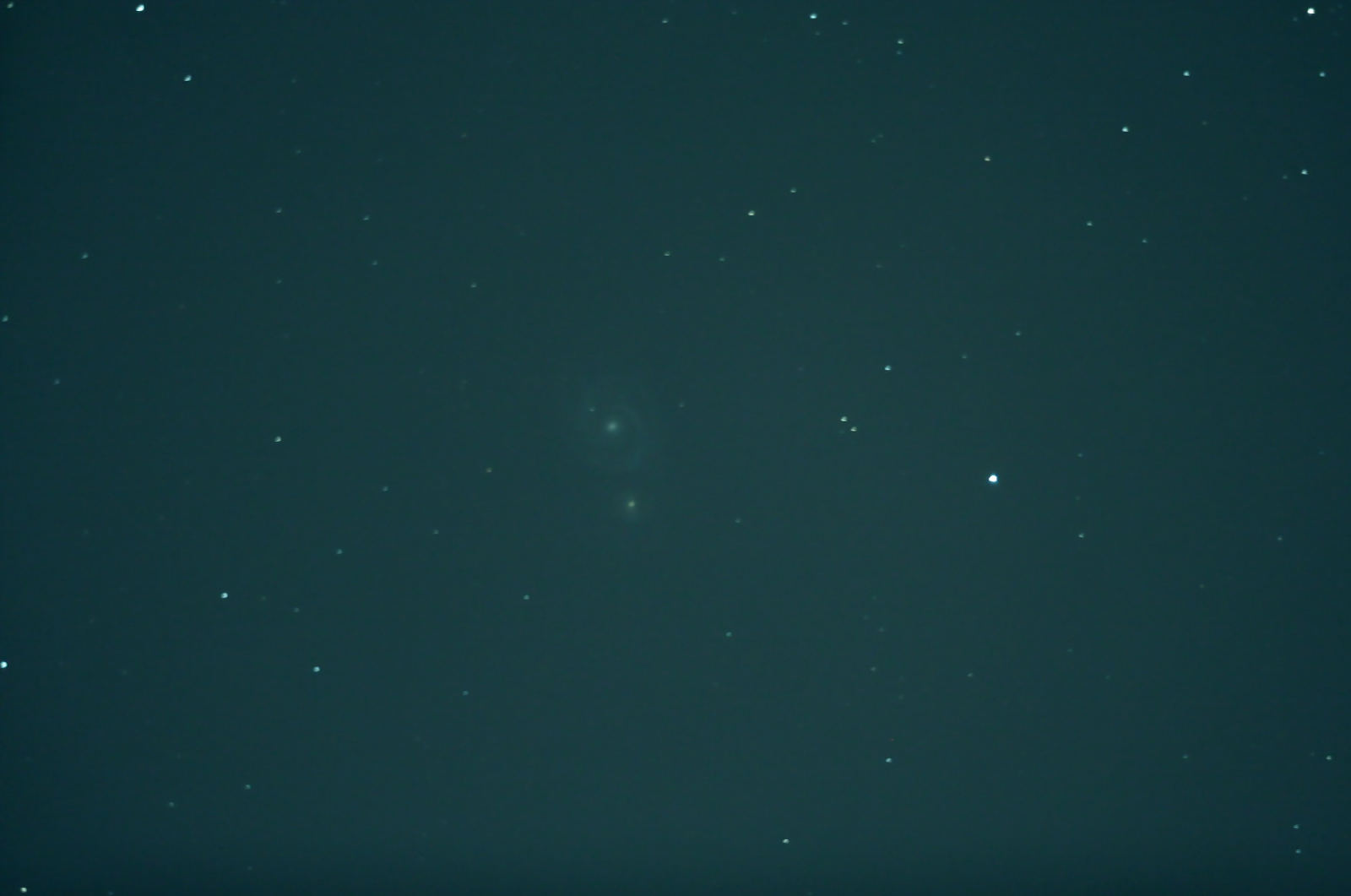
My first astrophotographic attempt


After acquired AP1200 DMA, I decide to try to see how good it was. It was a little bit chill yesterday night, I setup my whole rag and wait for night.

Telescope: Meade SN10, f4.0, schmidt newton reflector.
Camera: Canon 350D
Mount: AP1200 DMA
Target: whirlpool galaxy

Things I should do: prepare a focusing mask like bahtinov mask, choose a moonless night, better balance the mount.

Following is the 30 secs unguided photo


Sunday, October 4, 2015

My First Picture

I was planning to start my astrophotography hobby long time ago, there are lots of reasons for me to postpone, lack of time and equipment, wife not like it. etc. until this weekend ...

I happen to find a bargain of used AP 1200 equatorial mount, it has tracking problem. This weekend, my wife went with her women's group to santa cruz, so I can concentrate to fix my mount, it just need a new stepper motor driver chip!


The tracking is dead on! use 500x eye piece, the star is freeze for at least half hour. My first picture use Canon 350d is Epsilon Cygni, why it is so particular? because its Chinese name 天津,my home town

After Cygnus, constellation you can miss is Lyra, double-double is the one we definite want to picture

Thursday, June 5, 2014

Accurate Collimation for Newtonian Reflector

Collimate Newtonian telescope is easy when using the right tools, for me, astrosystem's light pipe is used to accurately square the focuser with secondary mirror. Kendrick laser is used to fast close the light path. and final touch on secondary is aided by autocollimator. The result is never seen before! Details of Mars are vivid, polar caps, dark brown region. all become clear at 450x!

Saturday, January 25, 2014

I see Sirius B tonight!

After I collimate my C14 as accurate as I can, I aim it at Sirius,  change eyepiece to nagler 7mm, I see a dim star locate east, about 10" from Sirius. It separate clearly. To eliminate possible ghost glare, I move out of focus slightly. it disappear, refocus, it get back. I am pretty sure it is Sirius-B!

Congratulate myself!

Thursday, May 30, 2013

Hunter's Two Dog

At begining of summer season, the Canes Venatici is close to zenith, it helps us to observe the deep sky objects within it. Canes Venatici has two major stars, a mag 3 star (Cor Caroli) and mag 4 star Chara

First object is M3, which is easy to locate around 40% from arcturus to cor caroli. It is completely resolved through my 16" with 7 mm EP, it is a globular contains yellow stars, like gold sand float in space.

Then M51 Wirlpool galaxy, is it generally use to test your star hopping ability, if you see anyone aiming at Alkaid at a star party, most of the time they are looking at M51, its spiral arms are sometime visible from silicon valley.

M63 Sunflower galaxy locates around 25% from Cor Caroli to Alkaid, look for a wedge arrangement in the area, M63 is 1.5 deg north from apex.

M94 is a bright, face on galaxy, look for a bright star 20% from Chara to Cor Caroli, center finder there, there are a cluster of stars perpendicular to the line connect alpha/beta on the edge of view circle, M94 is 1.5 deg east of the cluster.

M106 is a spiral galaxy that is devoured by a supermassive blackhole, most galaxy contains blackhole at center, our milky way contains a rather small blackhole (4 million sun) compare to Andromeda (200 million). God is merciful, or it is rather difficult for us!

Monday, May 20, 2013

Marvelous C14


I got a second hand Celestron 14" Schmidt Cassegrain telescope ($2,800) recently, I set it up during weekend, compare to my F4 newtonian reflector, it has much better contrast, the sky background is dark.

Use TV Panoptic 41mm, Saturn is beautiful, what surprise me is the dark background, I can easily pick out 9 mag stars, even better, NGC 5605 can be recognized with a little effort.

Conclusion: I have to praise Celestron engineers for their flag ship product - C14, it is the dream scope for light polluted sky.

Later on I did a little engineering to put sky commander digital setting circle and use parallel port to communicate with it. Now I can cruise through sky from my laptop, cool!

Tuesday, May 14, 2013

Queen's Hair

Coma Berenices is the only constellation named after a real person, queen of Eygpt, sacrifies her beatiful hair to goddess in return to her husband's safety return. The open cluster Mel 111, virgo galaxy cluster give add hint to her blonde hair.
Coma Berenices is near galaxy pole, so there are no star brighter than 4 mag, and lots of galaxies, include famous virgo cluster.
To observe most of the wonders, locate Gamma Com, point the finder scope at 40% from Denebola to Alkaid, the Mel 111 open cluster is easy to distinguish, focus on a binary star located as No. 4 from Gamma, then move east about 1deg. NGC 4565 is a side on spiral galaxy with dark absorbing line.
The alpha com is located 40% from arcturus to denebola, center the fiinder at a binary star less 1deg north- east. M53 will be in scope. Within my 16", 220x, M53 looks memorable, some granularity into the core.
About third from alpha to gamma, there is a 5 mag star, there is a 5 mag star, 35 comae, centered on it and look north-east about 1 deg, there is M64, the black eye galaxy, it has dark dust edge looks like a ladie's eye wear shade.
Compare to NGC 4565, M100 is a face on spiral galaxy, point the finder at 20% from denebola to arcturus, notice there are two array of 5-6 mag stars converging at about 90 deg in the finder scope, center the finder at intersection, M100 should be in the view, it is small and dimmer than M51, but is conceivable!